
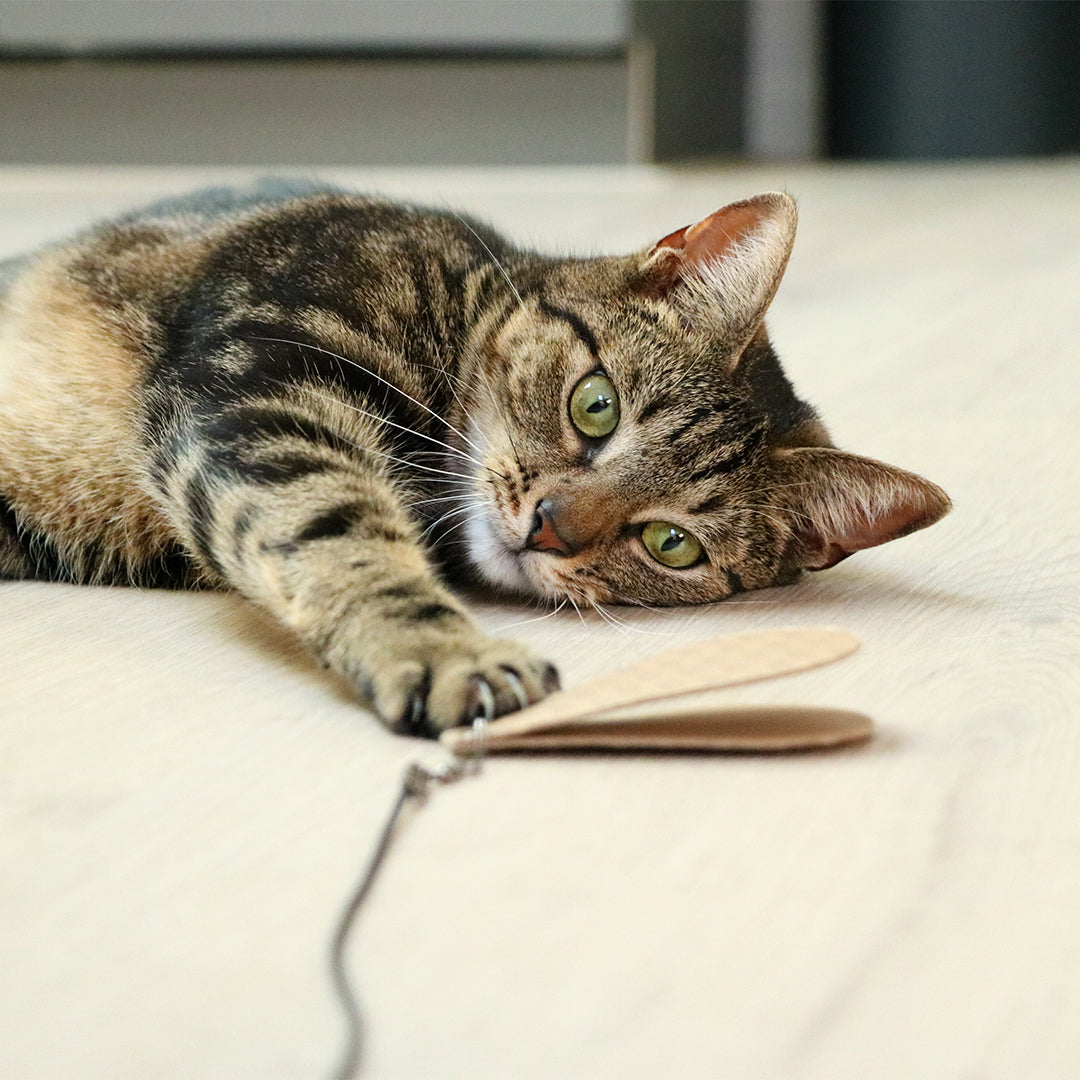
Cats are born hunters and we need to stimulate that instinct every day
Cats have an innate hunting instinct and want to chase moving and strongly-scented prey, whether they're hungry or not.
It's important to stimulate this hunting instinct every day, encouraging the cat to play with prey that moves, smells, or makes sound on its own, without the cat having to do anything for it.
Being stimulated in this way provides mental and physical enrichment that's essential for the cat's wellbeing and for preventing unwanted behaviour such as hunting aggression and house-soiling.
TIP 1 - Every day, 3 x a few minutes
Play with your cat a few minutes, several times a day. Make sure she can play alone, so separate your cats for a moment if needed.
When you play with two cats using one toy, one cat will always chase while the other waits its turn, and that's not what you want.
If you find it hard to remember, set a few reminders in your calendar or link playing to 'anchor moments', such as: when you get up, before you leave for work, when you get home, when you take off or put on your shoes, after you get up from the table, etc.
TIP 2 - Movement, smell & sound
Prey must either run away from the cat, make a sound like prey, or smell like prey, to be interesting to the cat. The colour of the prey makes no difference, even though you see all those different colours in the pet shop.
So use long wands with small prey attached that your cat can chase, and don't let her catch it. Even if you try this, your cat will probably outsmart you anyway and grab her prey.
Provide kick toys with dried valerian root, matatabi, and possibly also catnip, although you'll want to be careful with the latter since it has an exciting effect, and we often prefer our cats to calm down and become quieter.
TIP 3 - Rotate
It's very important to rotate enrichment. Cats experience 'prey habituation', which means they won't/won't want to play with prey they've already killed, or that's lying dead on the ground.
So clear away all the toys lying on the floor every day and replace them with other toys. Keep a few well-sealed containers in a cupboard, each with a different scent, and fill the container with all the mice, balls, and toys you have in the house. This way the scents can penetrate well, for the next time they fly around the house.
TIP 4 - Playing with the environment
Cats have another important form of play that you might not know yet: locomotor play, which means playing with the environment. Climbing, jumping, running, sprinting, seeking out heights, scratching lying down and standing up, biting, and so on. Sometimes cats get 'the zoomies', or 'go crazy' and run very fast across the couches.
This is a form of locomotor play that's a very important outlet for cats. Observe this behaviour and get creative with ideas on how you can make this easier for your cats so they can play with their environment safely and appropriately.
TIP 5 - Social play
Playing with another cat can sometimes get quite intense. Many owners quickly wonder whether they should intervene, but that's often not necessary. If you're in doubt, it's almost always play, because if it were fighting, you wouldn't be in doubt. Then there's growling, hissing, crying, and fur flying around.

9. Avoid Unfamiliar Cats
7. Leave Your Cat Alone